

9 Books That Help You Understand AI
For Your After Holiday Reading
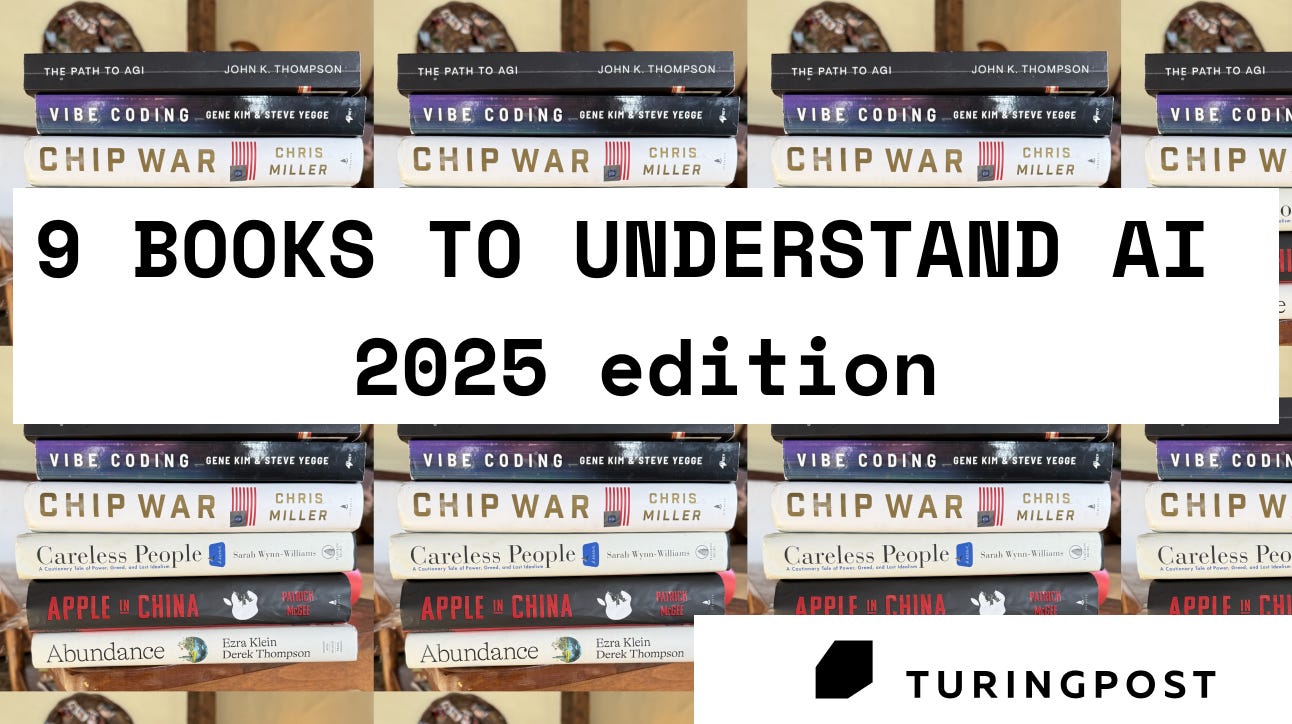
The holidays are over, and we still haven’t shared our favorite books from 2025.
To be honest, the year was hectic. Reading happened in fragments, between launches, interviews, deadlines, and the feeling that everything in AI was moving slightly faster than our ability to metabolize it. So this list is not exhaustive. It’s smaller than we wanted it to be. But it’s interesting and honest.
Before we start, make sure you’ve seen our 2023 recommendations (very good) and 2024 (amazing as well). They still hold up remarkably well, and together with this year’s list they form a pretty solid reading shelf for understanding where AI is actually going, not just where it is being advertised.
Last year’s list focused on the technical foundations of ML. This year, our selection reflects the massive shift in the landscape: the geopolitical tug-of-war over hardware, the internal races within Big Tech, and the quest for the ultimate milestone – AGI.
Star this collection and share with friends.
Power, Scale, and Unintended Outcomes (Understanding How Power Accumulates)
Apple in China: The Capture of the World’s Greatest Company by Patrick McGee
If you want to understand how and why China might win the AI race, you need to read this book. Though it’s not about AI at all.
Apple is used as a case study, but the book is really about how large technology companies interact with state capacity when scale becomes the primary objective. It documents how operational knowledge, manufacturing discipline, and capital investment were transferred into China over many years, contributing to the formation of an advanced industrial ecosystem.
These decisions were driven by efficiency and growth, not by geopolitical strategy. But once companies operate at sufficient scale, those distinctions stop mattering. Supply chains become political by default. Dependence limits optionality. Strategic leverage shifts without any explicit intent. The book’s value is in making this dynamic visible. And it’s brilliantly written.
If you want to understand how power actually accumulates in tech – and why AI isn’t going to be an exception – this book gives a lot of food for thoughts.
Reading Apple in China led me to reread Chip War: The Fight for the World’s Most Critical Technology by Chris Miller. The two books address the same landscape from different angles: one through corporate execution, the other through state competition. Read together, they provide useful context for current discussions about AI, compute, and industrial capacity.
When you think about chips, NVIDIA and Jensen Huang are immediately on your mind. This book is a reported biography of NVIDIA and its founder, focused on how the company moved from a graphics chip niche into a central position in modern computing.
The book traces NVIDIA’s technical and organizational evolution over several decades, with particular attention to Jensen Huang’s long-term bets on programmable hardware and software ecosystems such as CUDA. It documents how these choices positioned NVIDIA as a key supplier for contemporary AI workloads.
This is not a technical book about chips. Its value lies in showing how sustained architectural decisions, organizational culture, and timing shaped NVIDIA’s role in the current AI economy. If you want another book about NVIDIA’s way, here is one from the end of 2024: The Nvidia Way: Jensen Huang and the Making of a Tech Giant by Tae Kim
Let’s continue with giants. This book reads like a snapshot of the current moment in AI, taken from inside the industry.
Gary Rivlin – a veteran Pulitzer Prize–winning journalist – follows people rather than technologies: executives, founders, investors, researchers. Microsoft and Google are central, but the story moves across the broader ecosystem, including startups that rise quickly and disappear just as fast. The emphasis is on decisions, incentives, and timing, not on how models work.
What comes through clearly is how expensive this phase of AI has become, and how that shapes who gets to participate. Training costs, infrastructure, and access to capital quietly narrow the field. The book doesn’t argue this point. It simply shows it happening.
It’s a useful read if you want to understand how AI moved from research and experimentation into large-scale commercialization, and what that shift looks like from the inside.
Source Code: My Beginnings by Bill Gates
Naturally following out of the previous book, is this one, written about Bill Gates by Bill Gates. This is a much narrower book than the title might suggest. It focuses on Gates’s early years, before Microsoft became a company with global reach.
One detail that stays with you is the role of his mother, Mary Maxwell Gates. The book makes it clear that access, expectations, and exposure to institutions mattered early on. Her professional and civic networks shaped opportunities that later tend to be described as luck or coincidence. In short: she was really cool, and that’s why Bill became who he became.
The book is not trying to revise the Microsoft story. It shows how tech ability develops alongside family context and social structures, long before outcomes are visible.